Scan QR code to download the
application.
Worth Four Dot Test (W4LT)
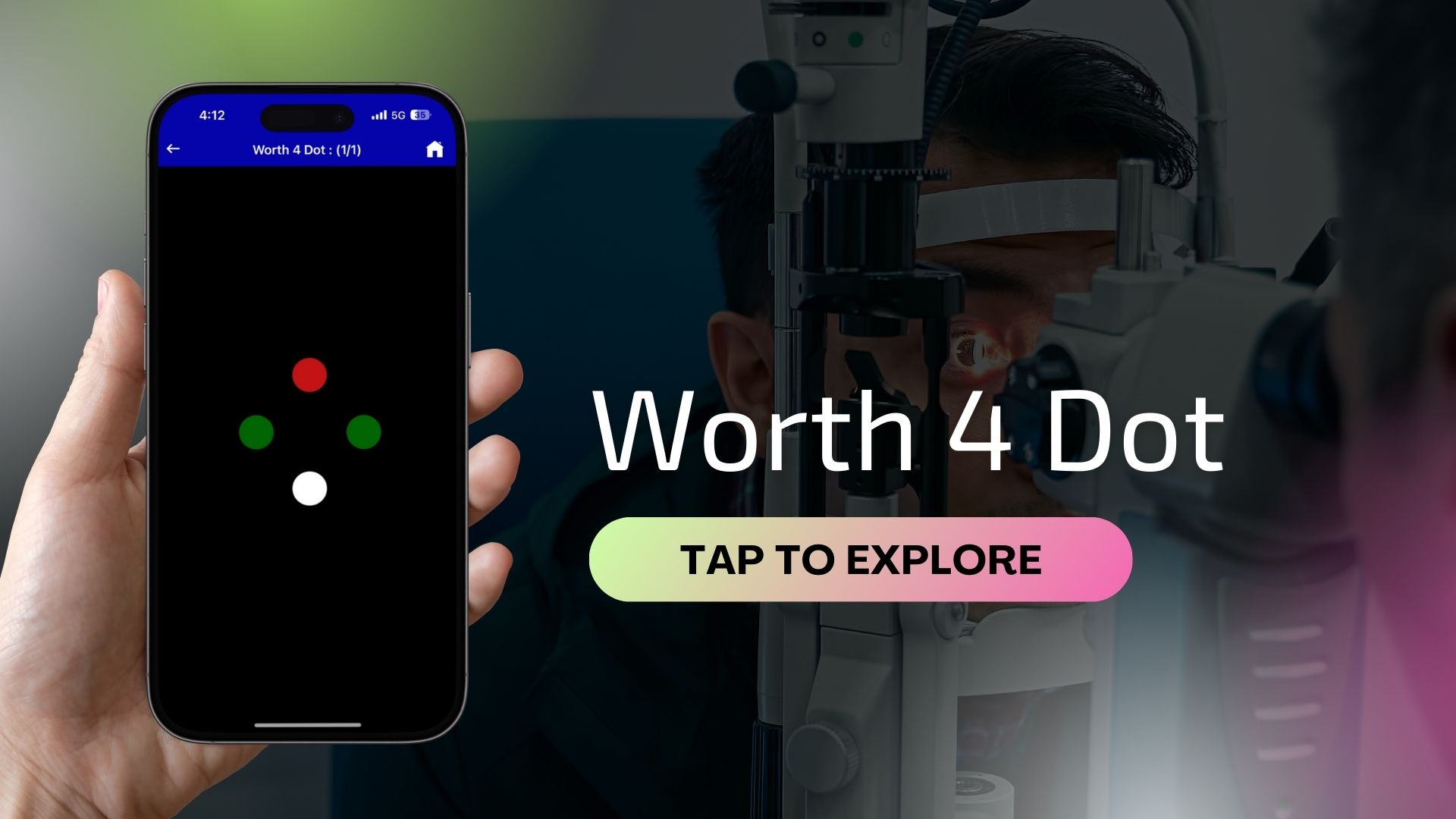
The Worth Four Dot Test, also known as Worth's Four Dot Test
or W4LT, is a method used to evaluate binocular vision. It
specifically helps in assessing fusion, suppression, and
anomalous retinal correspondence (ARC). The test involves
the use of a special flashlight or screen displaying four
dots in specific colors—typically red, green, and white. The
patient wears red-green glasses during the test to
differentiate the dots seen by each eye. This setup allows
examiners to determine if both eyes are contributing equally
to vision or if one is being suppressed. It also helps in
identifying any misalignment between the eyes that may not
be obvious during regular vision testing. The Worth Four Dot
Test is particularly useful in diagnosing and managing
strabismus and amblyopia. It is often performed in both
well-lit and dimly lit environments to assess vision under
different conditions. Results from the test guide treatment
decisions, such as vision therapy, prism correction, or
surgical intervention. Overall, it is a simple yet effective
method for understanding how the eyes function together.
Purpose of the Test
- Assess Binocular
Vision: Evaluate how
well the two eyes work together to create a single,
fused image.
- Detect Suppression:
Identify if either
eye is being ignored by the brain, a common issue in
conditions like strabismus or amblyopia.
- Identify Anomalous Retinal Correspondence
(ARC): Determine if there is any unusual
alignment or correspondence between the images seen by
the two eyes.
Setup
- Environment: Perform
the test in a
well-lit room to ensure clear visibility of the
lights.
- Equipment:
- Four Lights: Typically include
two green, one
red, and one white light.
- Red-Green Glasses or Goggles: These are worn by
the patient to filter the light as it reaches
each eye.
Procedure
1. Initial Instructions:
Explain the test to the patient, ensuring they understand
they will be looking at a set of lights through colored
glasses.
2. Testing Procedure:
- Place Glasses on
Patient: Equip the
patient with red-green glasses or goggles.
- Present the Four
Lights: Show the set
of lights to the patient. The arrangement usually
includes:
- Two Green Lights: For one
eye.
- One Red Light: For the other
eye.
- One White Light: Visible to both eyes or not
clearly associated with either.
- Ask the Patient to Report What They
See: The patient should describe the number
and color of the lights they perceive.
Evaluation Criteria
- Normal Results: The patient should see:
- Two Green Lights: Indicating
normal binocular
vision and proper fusion.
- One Red Light: Specific to one
eye.
- One White Light: Should be seen if both eyes are
functioning normally, with the potential to be
fused with other lights.
- Abnormal Results:
- Suppression:
If the patient
only sees three lights or if the red or green
lights are missing, it may indicate suppression
in one eye.
- Anomalous Retinal Correspondence
(ARC): If the pattern of lights
does not match expectations, it may suggest an
abnormal alignment or correspondence between the
two eyes.
Interpretation of Results
- Normal Fusion: Seeing
all four lights
correctly and in the correct colors suggests normal
binocular vision and no significant suppression or
ARC.
- Suppression or ARC: If there are
discrepancies in the lights seen (such as missing lights
or incorrect colors), it could indicate issues such as
suppression, strabismus, or ARC.
Follow-Up
- Further Evaluation: If
abnormalities
are detected, additional tests by an ophthalmologist or
optometrist may be needed to diagnose and address
underlying conditions.
- Treatment or Intervention: Based on
findings, appropriate interventions may include vision
therapy, corrective lenses, or other treatments aimed at
improving binocular vision and addressing suppression or
misalignment issues.
The Worth Four Dot Test is a valuable and straightforward
method for assessing the coordination and function of the
eyes, particularly useful for detecting issues related to
binocular vision and suppression.