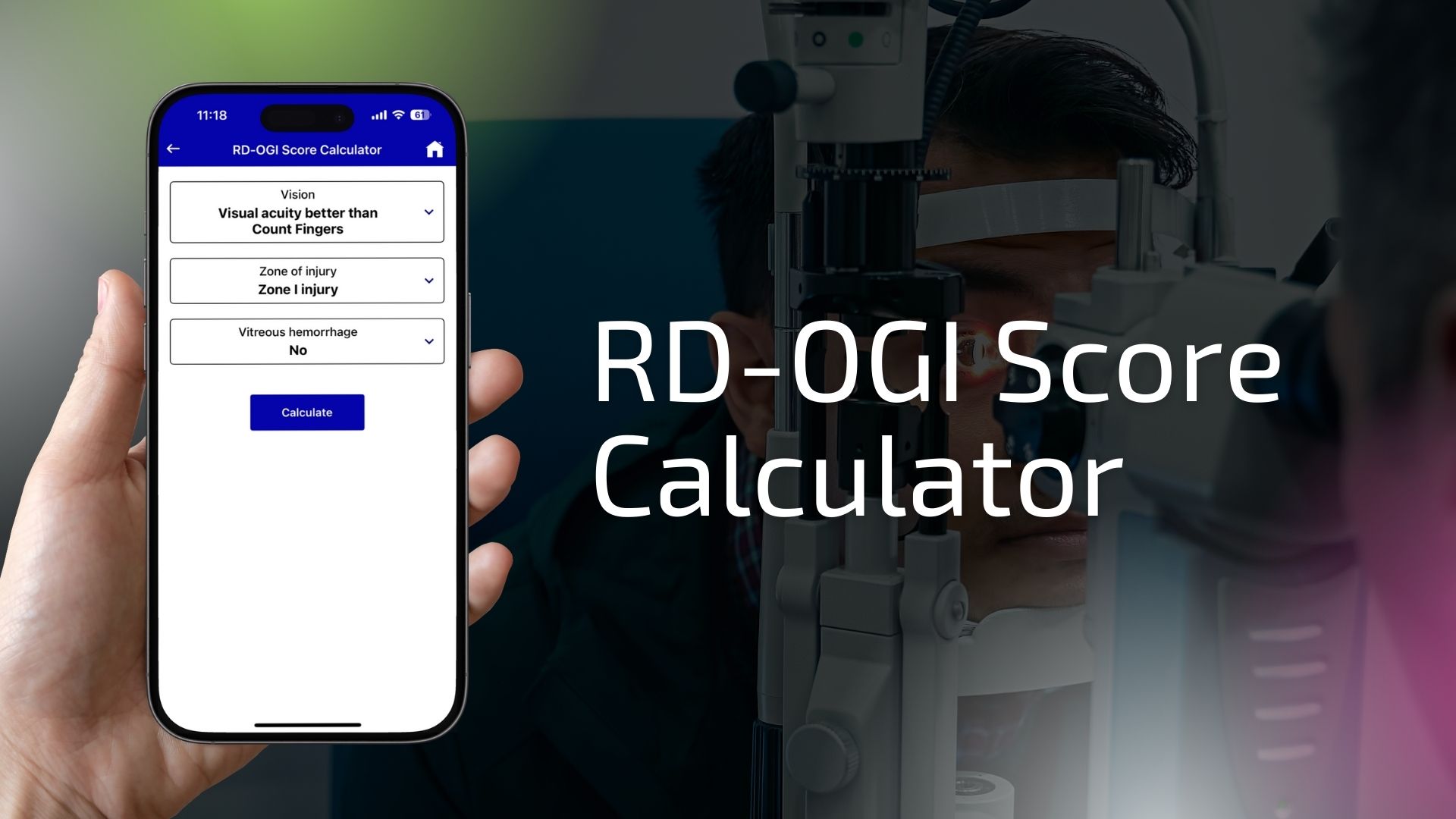

The RD-OGI Score is a clinical tool used to estimate the visual prognosis in patients with retinal detachment (RD) resulting from ocular trauma. It takes into account three primary factors: Vision, Zone of Injury, and Vitreous Hemorrhage. These factors are converted into a percentage-based estimate of the likelihood of achieving a good visual outcome (20/40 or better).
The best recorded visual acuity in the injured eye at presentation, before any surgical intervention.
| Visual Acuity | Points |
|---|---|
| Better than Count Fingers (CF) | 0 |
| Count Fingers (CF) at 2 feet | 2 |
| Hand Motion (HM) at 2 feet | 3 |
| Light Perception (LP) | 4 |
| No Light Perception (NLP) | 5 |
The location of the injury within the globe, classified into three zones:
| Zone | Description | Points |
|---|---|---|
| Zone I | Cornea and limbus (anterior segment injury) | 0 |
| Zone II | Anterior 5 mm of the sclera | 2 |
| Zone III | Posterior to 5 mm from the limbus, retinal or optic nerve involvement | 4 |
Blood in the vitreous cavity, typically associated with retinal trauma, indicating more severe damage.
| Vitreous Hemorrhage | Description | Points |
|---|---|---|
| No | No vitreous hemorrhage present. | 0 |
| Yes | Vitreous hemorrhage present. | 4 |
To calculate the RD-OGI total score, sum the points from all three categories:
Total RD-OGI Score = Vision Points + Zone of Injury Points + Vitreous Hemorrhage Points
After calculating the total RD-OGI score, you can estimate the percentage likelihood of a good visual outcome (functional vision, i.e., 20/40 or better). The higher the total score, the lower the chance of a good outcome.
| RD-OGI Total Score | Percentage Likelihood of Good Visual Outcome (20/40 or better) |
|---|---|
| 0 - 2 | 80% - 100% |
| 3 - 5 | 50% - 79% |
| 6 - 9 | 20% - 49% |
| 10+ | 0% - 19% |
Patient Example:
Total RD-OGI Score = 2 (Vision) + 2 (Zone) + 4 (Vitreous Hemorrhage) = 8
Prognosis: 20% - 49% chance of a good visual outcome (light perception to 20/400 vision).
The RD-OGI score provides a general guide to prognosis based on initial presentation and does not account for post-surgical recovery or other clinical factors (e.g., comorbidities).
Outcome variability: Visual outcomes may differ based on the timing of surgical intervention, quality of care, and patient-specific factors like comorbid conditions (e.g., diabetes, hypertension).
This tool is intended for prognostic estimation and patient counseling and should be used in conjunction with clinical judgment.