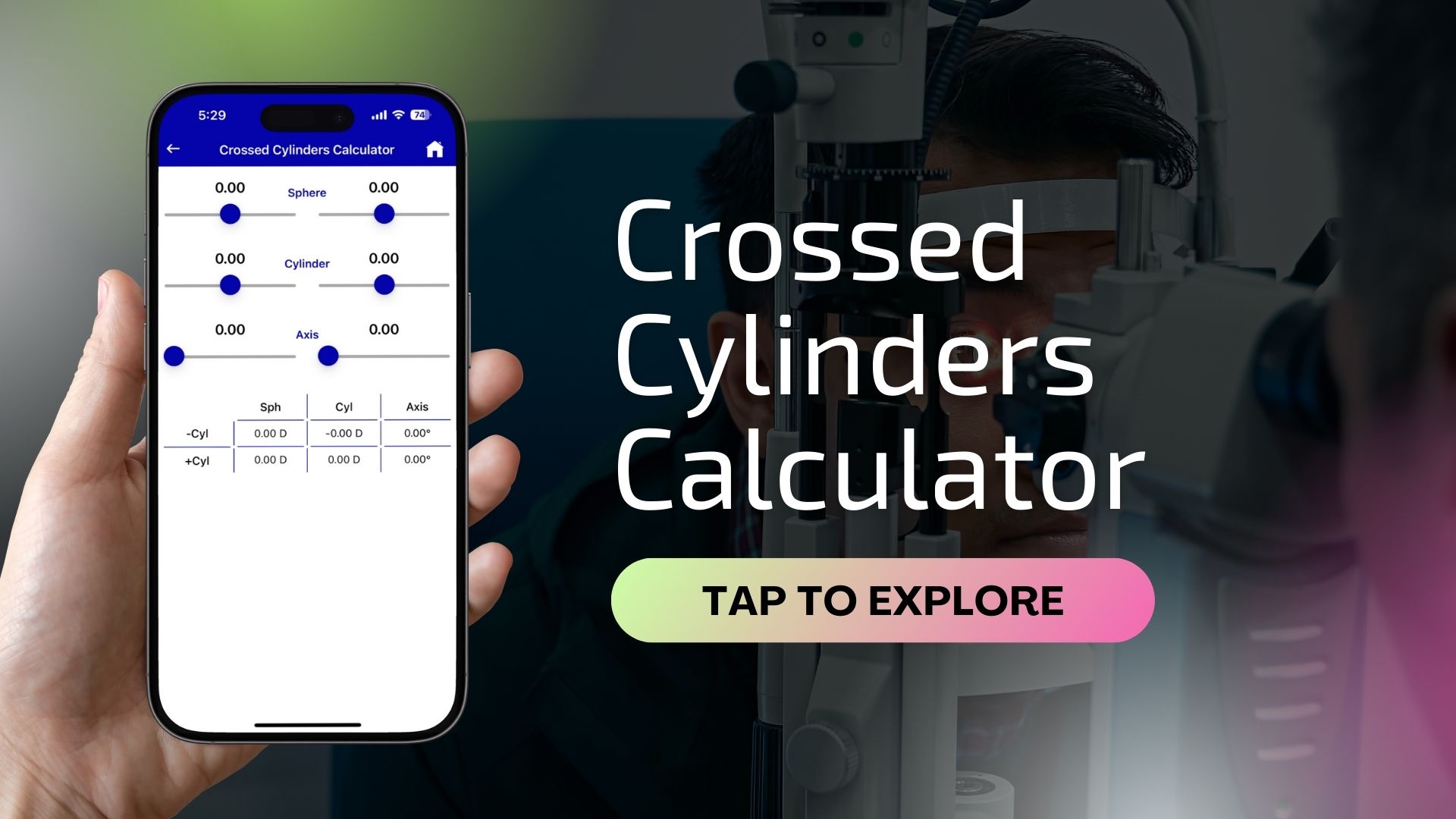
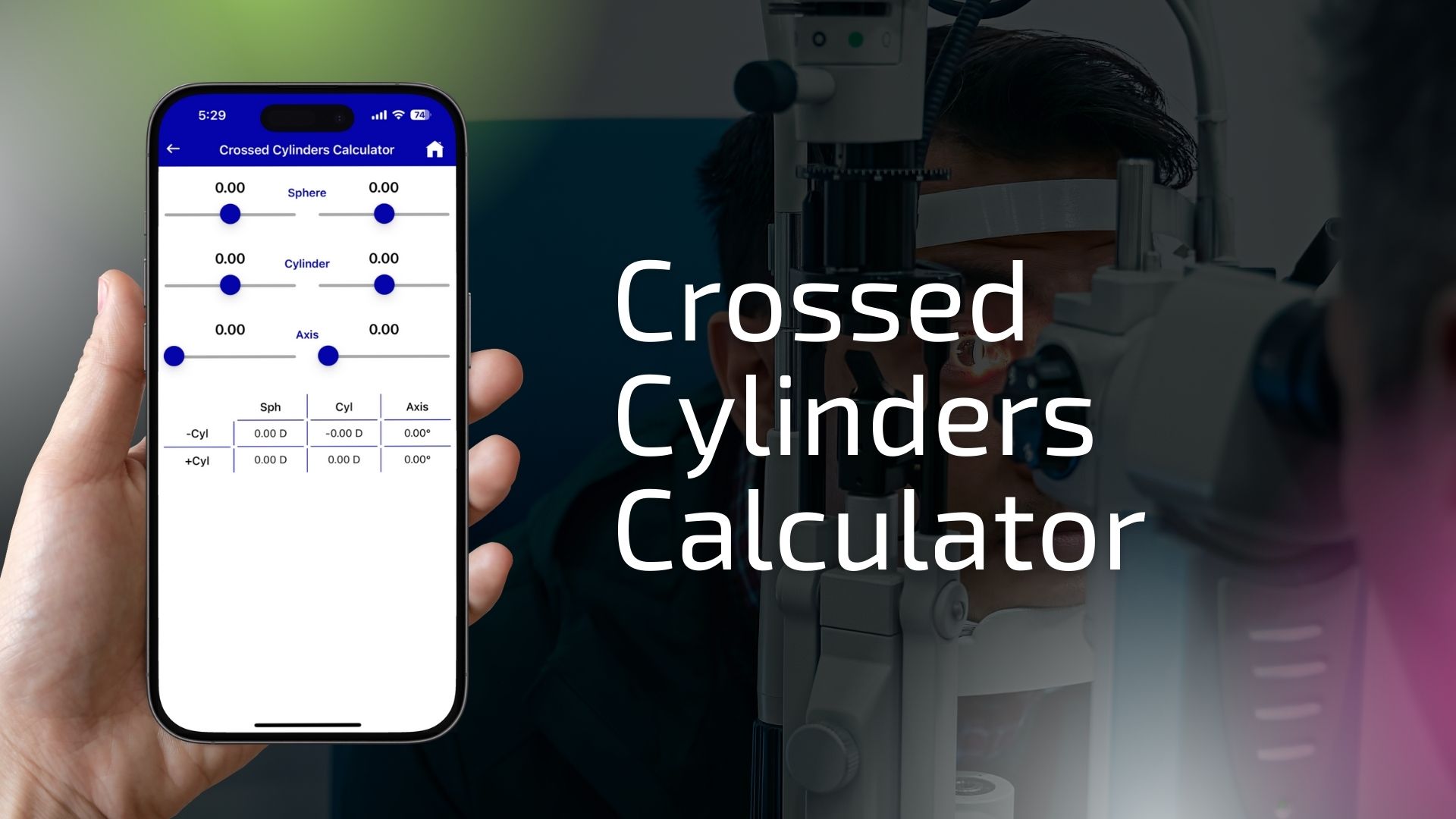
Crossed cylinders refer to the method of
combining two cylindrical lenses with different powers,
typically used to correct astigmatism. This technique is
widely used by optometrists and ophthalmologists. It
allows them to assess the net effect of the two
cylindrical lenses when placed at different axes. By
doing this, they can create a single prescription that
corrects the vision more accurately. Each cylindrical
lens has its own axis and power. When combined, the
lenses work together to correct the distorted vision
caused by astigmatism. The overall goal is to refine the
astigmatism correction to provide clear, sharp vision.
Crossed cylinders can be adjusted to ensure the most
precise result. The method is important for achieving
high-quality vision correction. Ultimately, it ensures
that the patient receives the most accurate
prescription.
How Crossed Cylinders Work
In astigmatism correction, light
entering
the eye does
not focus properly due to the irregular curvature of the
cornea or lens. Two cylindrical lenses with different
powers and orientations can be used to correct this
irregularity. The goal of crossed
cylinders is to find the resulting
power and axis when these
two lenses are combined.
- Cylinder Lenses:
These lenses have
curvature in only one direction, either vertical or
horizontal, as opposed to spherical lenses, which
have curvature in all directions.
- Combining Cylinders: When two
cylindrical lenses are combined (i.e., crossed), the
result is a new prescription that accounts for both
powers and their respective axes. This is useful in
refining astigmatism corrections.
Using Crossed Cylinders
Calculator
A Crossed Cylinders
Calculator is a tool
designed to simplify the process of combining two
cylindrical lenses into one resultant prescription. It
is commonly used by optometrists, ophthalmologists, and
optical professionals.
Inputs for the Calculator
- Power of the first
cylindrical lens
(C₁): The refractive power of the first
cylindrical lens, typically given in diopters
(D).
- Power of the second
cylindrical lens
(C₂): The refractive power of the
second cylindrical lens.
- Axis of the first
cylindrical lens
(θ₁): The orientation (in degrees) of
the first cylinder.
- Axis of the second cylindrical lens
(θ₂): The orientation (in degrees) of
the second cylinder.
Output from the Calculator
- Combined Power:
The resultant
refractive power when the two cylindrical lenses are
combined.
- Combined Axis: The orientation of
the resulting cylindrical lens that can be used for
correcting astigmatism.
Why Use a Crossed Cylinder
Calculator?
Optometrists use a crossed cylinder
calculator for
several reasons:
- Accuracy: It
provides precise
results for determining the effective power and axis
when two cylindrical lenses are used together.
- Efficiency: It
simplifies the
calculation process, saving time compared to manual
calculations.
- Consistency: It reduces human
error, ensuring that the resulting prescription is
as accurate as possible.
Practical Applications
Crossed cylinders are used in various
optical
applications:
- Astigmatism
correction: For
patients with astigmatism, crossed cylinders are
often used to refine prescriptions.
- Contact lenses:
They are also
helpful in adjusting contact lens prescriptions,
especially for those with astigmatism.
- Eyeglasses: Crossed cylinders can
help in determining the best corrective lens
combination for eyeglasses.