Scan QR code to download the
application.
Contrast Sensitivity (CS) Eye Test
Overview
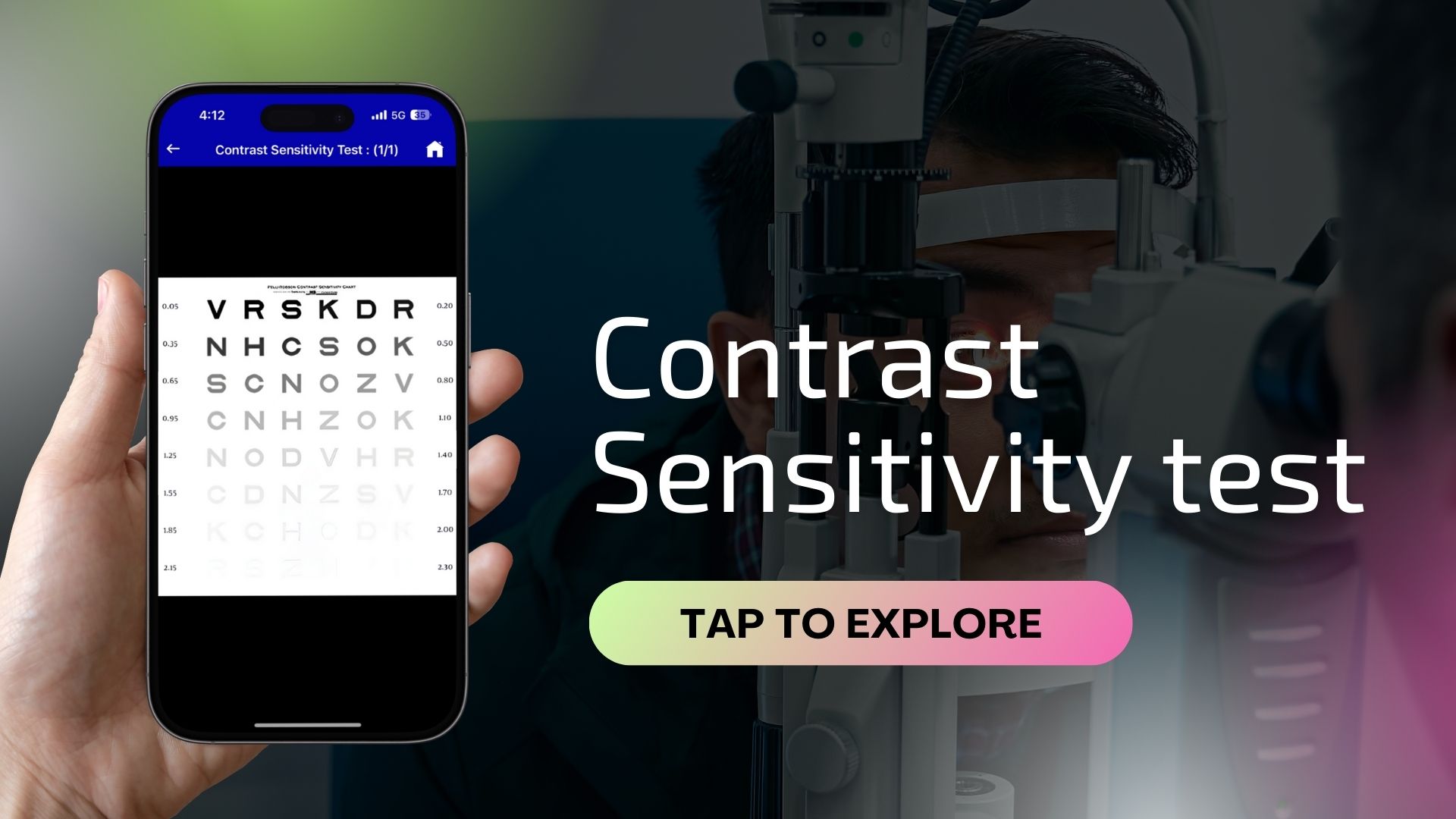
Contrast Sensitivity (CS) measures the ability to detect
subtle differences in light and dark areas, helping
individuals see object details even in low contrast. Unlike
traditional visual acuity tests, which assess sharpness at
specific distances, CS evaluates the ability to identify
objects with varying contrast levels. This skill is crucial
for activities like driving at night or navigating in fog.
Poor CS can indicate visual impairments like cataracts or
glaucoma. CS testing uses patterns with changing contrast,
providing a more accurate measure of real-world vision than
standard acuity tests.
Key Concepts in Contrast Sensitivity:
1. Definition:
- Contrast Sensitivity: The
ability to
detect small differences in light between objects and
their background, even when these objects do not have
well-defined borders.
- Contrast Threshold: The
minimum
contrast level required for an object to be perceived
clearly. Contrast sensitivity is the reciprocal of this
threshold.
2. Importance:
- Visual Acuity vs. Contrast
Sensitivity:
A person can have 20/20 visual acuity but still
experience a significant loss of contrast sensitivity,
which can impact daily activities and quality of life.
Contrast sensitivity loss can be more psychologically
challenging than loss of visual acuity.
- Clinical Significance: Low
contrast
sensitivity can be an early indicator of ocular diseases
such as glaucoma, diabetic retinopathy, and age-related
macular degeneration.
3. Measurement Methods:
- Arden Grating Test
- Cambridge Low Contrast Grating
Test
- Pelli-Robson Contrast Sensitivity
Chart
- Bailey-Lovie Chart
- Vision Contrast Test System (VCTS)
- Vistech Chart
- Regan Chart
- FACT (Functional Acuity Contrast Test) Chart
4. Factors Affecting Contrast
Sensitivity:
- Luminance: The
brightness level of the
test target and background.
- Target Type: Various
shapes and
patterns can influence sensitivity.
- Grating Motion: Moving
gratings can
affect the sensitivity measurements.
- Grating Shape: The configuration of the
gratings used in the test.
Clinical Factors:
- Refractive Errors:
Impair vision
sharpness and contrast sensitivity.
- Age: Contrast
sensitivity typically
declines with age.
- Eye Conditions:
Cataracts, glaucoma,
diabetic retinopathy, and optic neuropathy can impact
sensitivity.
- Surgical
Interventions: Cataract
surgery and refractive surgeries can affect contrast
sensitivity.
- Neurological Conditions: Pituitary
adenomas and other neurological issues can influence
contrast perception.
5. Historical Context:
- Early Measurements:
Schade first
measured contrast sensitivity using the modulation
transfer function.
- Modern Techniques: Campbell and Green's
work in 1968 introduced sinusoidal gratings to measure
contrast sensitivity, highlighting its complexity and
dependence on retinal function.
Clinical Implications:
- Diagnosis and
Monitoring:
Contrast
sensitivity testing helps in diagnosing and monitoring
various eye conditions that may not be apparent with
standard visual acuity tests.
- Treatment Planning:
Understanding
contrast sensitivity loss can guide treatment strategies
and rehabilitation for individuals with vision
impairments.
For accurate assessment and interpretation of contrast
sensitivity, it is important to consult with an eye care
professional who can provide detailed testing and insights
based on individual visual needs and health conditions.