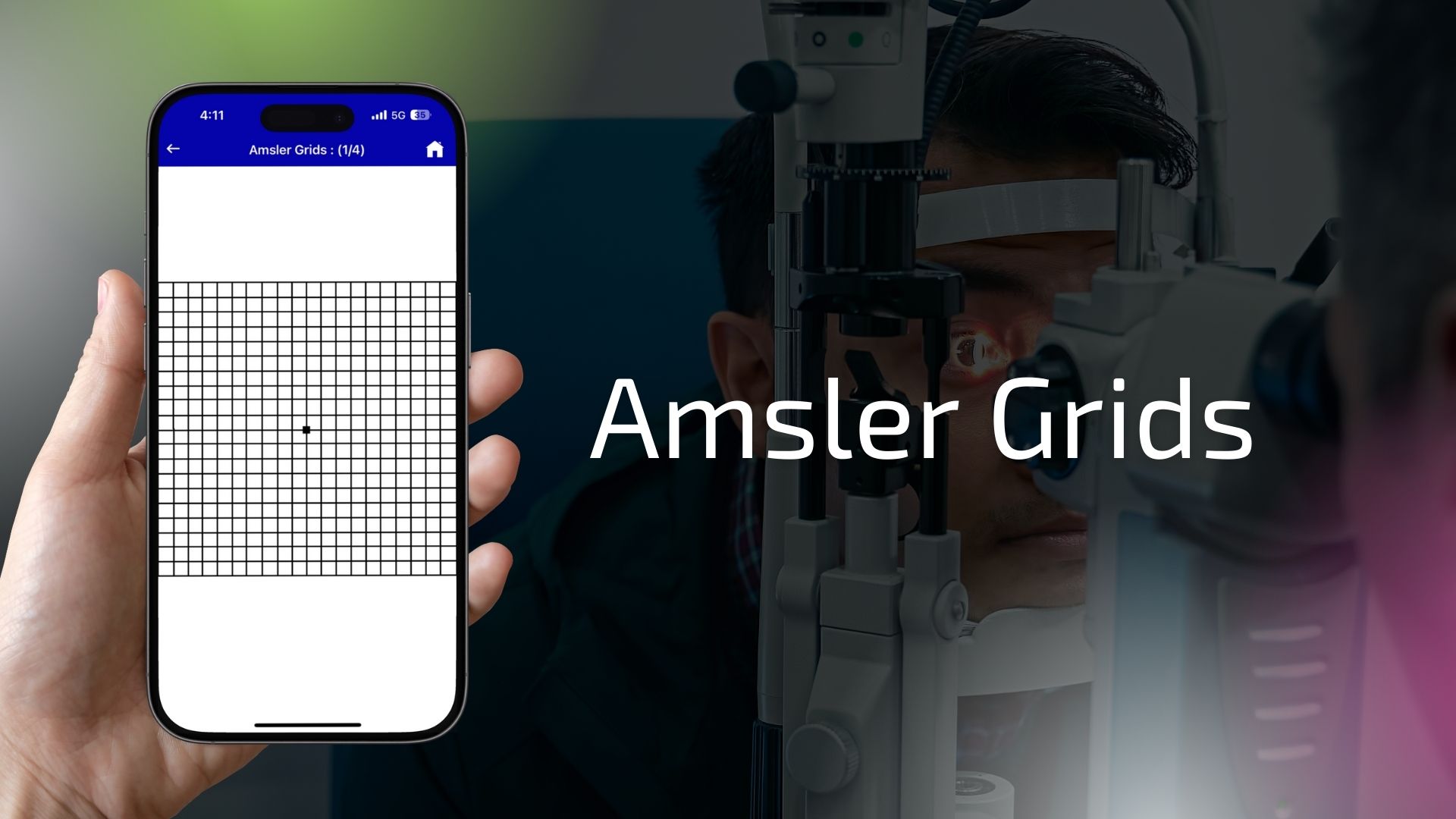
Scan QR code to download the
application.
Here’s a refreshed overview of using the Amsler grid for
detecting early signs of retinal disease and monitoring
age-related macular degeneration
Using the Amsler Grid
The Amsler grid is a simple yet effective tool that can
be used at home to monitor your vision. It’s especially
useful in detecting early warning signs of retinal
conditions, most notably age-related macular
degeneration (AMD). AMD is a leading cause of vision
loss in older adults, and catching changes early can
make a significant difference in how it progresses. For
individuals who have already been diagnosed with AMD,
regularly using the Amsler grid can help track the
disease over time and identify any noticeable changes in
vision. This is particularly important when monitoring
for a potential shift from dry AMD to the more
aggressive wet AMD, as early detection allows for
quicker medical intervention, which can preserve vision
and improve long-term outcomes.
How to Use the Amsler Grid?
1. Obtain the Grid:
- Use the Amsler grid provided here or download
and print
a free version on plain white paper.
2. Prepare for the Test:
- Wear your reading glasses to ensure you can
see the grid
clearly. Hold the grid at a reading distance of
about
12-14 inches from your eyes.
3. Perform the Test:
- Cover One
Eye: With one eye
covered,
focus on the black dot in the center of the
grid.
- Repeat for the Other Eye:
Cover the
other eye and repeat the process.
4. Observe the Grid:
- Look for any distortions such
as wavy, dim,
irregular,
or fuzzy lines.
- If you notice any abnormalities, contact your
eye care
professional immediately to schedule an eye
exam.
5. Frequency:
- Perform the test once a week to monitor any
changes.
6. Convenience:
- To make the test more accessible, request a
magnetic
version of the Amsler grid by calling
1-855-345-6637, so
you can place it on your refrigerator for easy
access.
Important Testing Tips:
- Test One Eye at a Time:
Always cover or
close one eye while testing to avoid compensatory
vision
from the unaffected eye.
Interpreting Results:
- A healthy eye will typically see all the lines
as
straight.
- An eye affected by wet AMD may see lines as
curved, or
there may be areas obscured by gray, white, or black
regions. This distortion is often caused by fluid
accumulation or new leaky blood vessels under the
retina, forming a blister that affects the visual
field.
Treatment Options:
- If abnormalities are detected, early
intervention is
crucial. Treatments for wet AMD may include
medications
such as brolucizumab (Beovu®), aflibercept (Eylea®),
ranibizumab (Lucentis®), or bevacizumab (Avastin®).
These medications are administered via injections
into
the eye, typically on a monthly basis.
- For more information on treatments and
managing AMD,
consult with your eye care provider.